
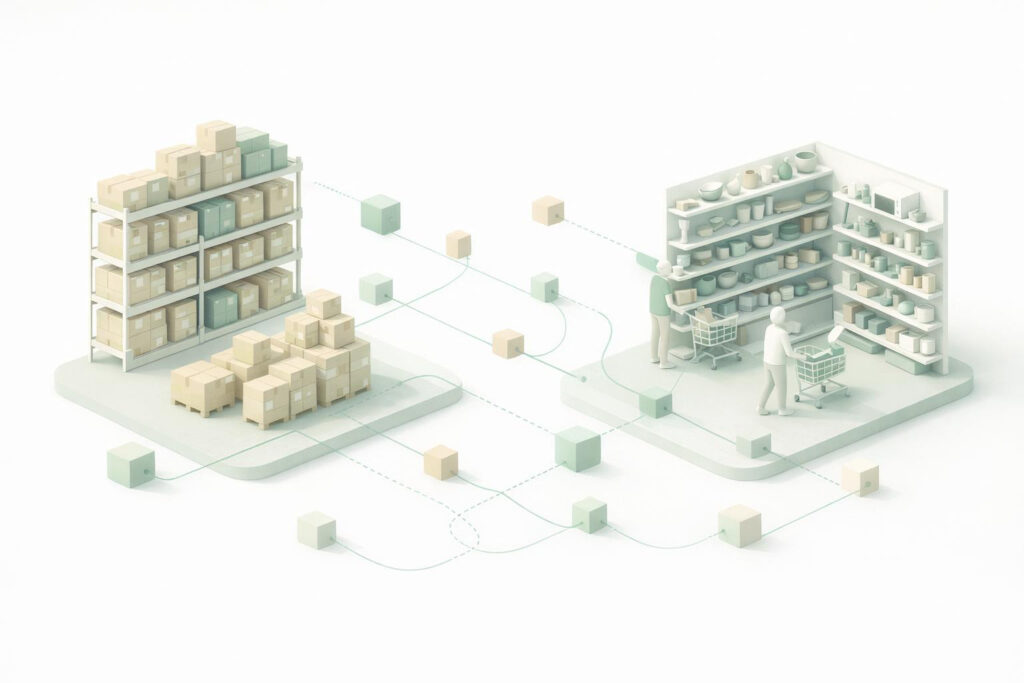

There are no customers in a supplier's warehouse

What is Consignment Stock Management?

How suppliers, distributors, and trade businesses move stock smarter, reduce risk, and speed up sales.

What Consignment Stock Actually Is

Consignment stock is a supply-chain model where the supplier owns the stock, but it sits physically at the customer’s location. The customer only pays when the stock sells or is used.
This gives

  • Suppliers more reach and more sales opportunities
  • Customers immediate access to stock without upfront cost

It’s inventory without friction.

How Consignment Stock Management Works

Managing consignment stock means tracking:

  1. Transfers in and out, between organisations
  2. Sales and usage
  3. Returns and credits
  4. Cycle closes
  5. Final reconciliations & invoicing


Every action needs a timestamp, an ownership state, and a clean audit trail.

Without a structured system, this becomes messy fast.

Why Do Businesses Use Consignment?

Suppliers (Consignors)

  • Reduce warehousing and holding costs

  • Redistribute stock to Consignees where it sells

  • Boost visibility and first-call advantage

  • Increase sales without increasing inventory

  • Strengthen customer loyalty

Customers (Consignees)

  • Stock on hand without tying up cash, creating positive cash flow

  • Faster job turnaround

  • Less admin, less frustration

  • Zero capital risk

  • Improved availability for their own customers

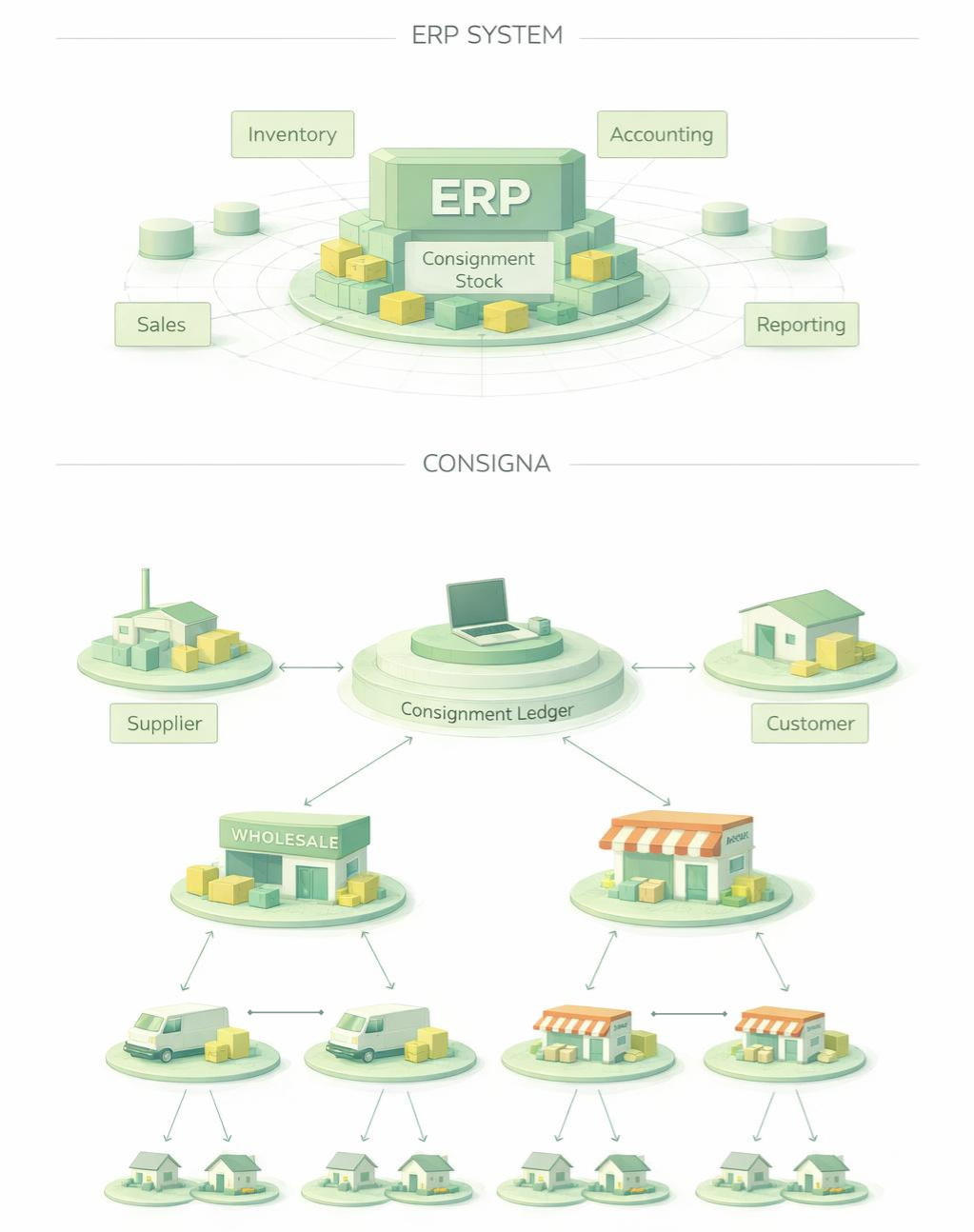
Why Consigna isn't an ERP

An ERP is designed to run an entire business. It’s a broad, powerful system built to manage inventory, sales orders, warehouses, channels, accounting integrations, and reporting, all under one roof. When it comes to consignment, ERPs can support it, but only as a configuration: extra locations, manual transfers, workarounds, and rules that assume one owner and one source of truth. It works, but it’s engineered from an internal-control mindset, not a shared-ownership one.

Consigna is different by design. It isn’t trying to be everything — it’s a precision tool built specifically for consignment workflows. Shared agreements, locked reconciliation cycles, dual-party visibility, and real-time stock accountability aren’t add-ons or hacks; they’re the foundation. Consigna assumes stock will live outside your four walls, that ownership and usage are split, and that trust must be enforced by the system, not spreadsheets, emails, or “we’ll sort it out at month-end.”

The difference comes down to intent. If consignment is a small edge case inside a much larger operational machine, an ERP makes sense. But if consignment is a strategic growth model — driving availability, reducing friction, and strengthening supplier-customer relationships — then a general-purpose ERP will always feel heavy and awkward. Consigna delivers a smoother, lower-pain, more accurate way to run consignment because it was built for that job, and only that job, from day one.

The Consignment Cycle Explained

Consignment operates in defined periods. Each cycle records:

  • Opening balance
  • Transfers between Consignors and Consignees
  • Transfers between Consignees and Sub-Consignees
  • Transfers between Sub-Consignees
  • Purchases and Disposals
  • Usage, sales, returns
  • Final closing quantity
  • Automated reporting for what was used

If cycles aren’t tight, errors multiply and disputes follow.

Best Practices for Running Consignment Stock

Businesses that follow the following process, experience fewer errors and faster replenishment:

  • Use consistent cycle dates
  • Track every movement instantly
  • Lock transactions to a timeframe
  • Scan barcodes for accuracy
  • Reconcile digitally, not manually
  • Keep ownership states visible to all parties
  • Use mobile capture in the field

Where Consignment Works Best

  • Retail & homewares
  • Hospitality & Restaurants
  • Manufacturing & assembly
  • Medical, pharmaceutical & healthcare supply
  • Electrical wholesalers & suppliers
  • Lighting & HVAC distribution
  • Plumbing & industrial trades
  • Galleries, Boutiques and Curio Shops

Wherever stock needs to be close to the customer, consignment thrives.

The Payoff

  • More stock in front of customers
  • Less money tied up in warehouses
  • Faster sales cycles
  • Cleaner accounting
  • No disputes at month‑end
  • Happier suppliers and consignees

Consignment isn’t just a stock model. It’s a smarter way to do business.

If cycles aren’t tight, errors multiply and disputes follow.

Multi-Entity Consignment

Managing Stock Across Complex Chains

Modern supply chains often involve multiple layers: suppliers, wholesalers, sub-consignees, and field technicians. This guide explains how multi-entity consignment works and how to manage it effectively.

Read more
Consignor vs Consignee Roles
Consignor vs Consignee

Roles, Responsibilities, and Ownership

A clear explanation of the consignment relationship: who owns the stock, who holds it, who uses it, and when payment is triggered.

Read more
How to reduce stockholding costs
Stockholding Costs

How to Reduce Stockholding Costs Without Reducing Stock Levels

Stockholding is one of the largest hidden expenses in supply-chain-driven businesses. This guide details the true cost of holding inventory and how shifting stock closer to demand through consignment lowers costs while increasing sales.
Read more
Electrical Distributors

Consignment Stock for Electrical Distributors: A Practical Guide

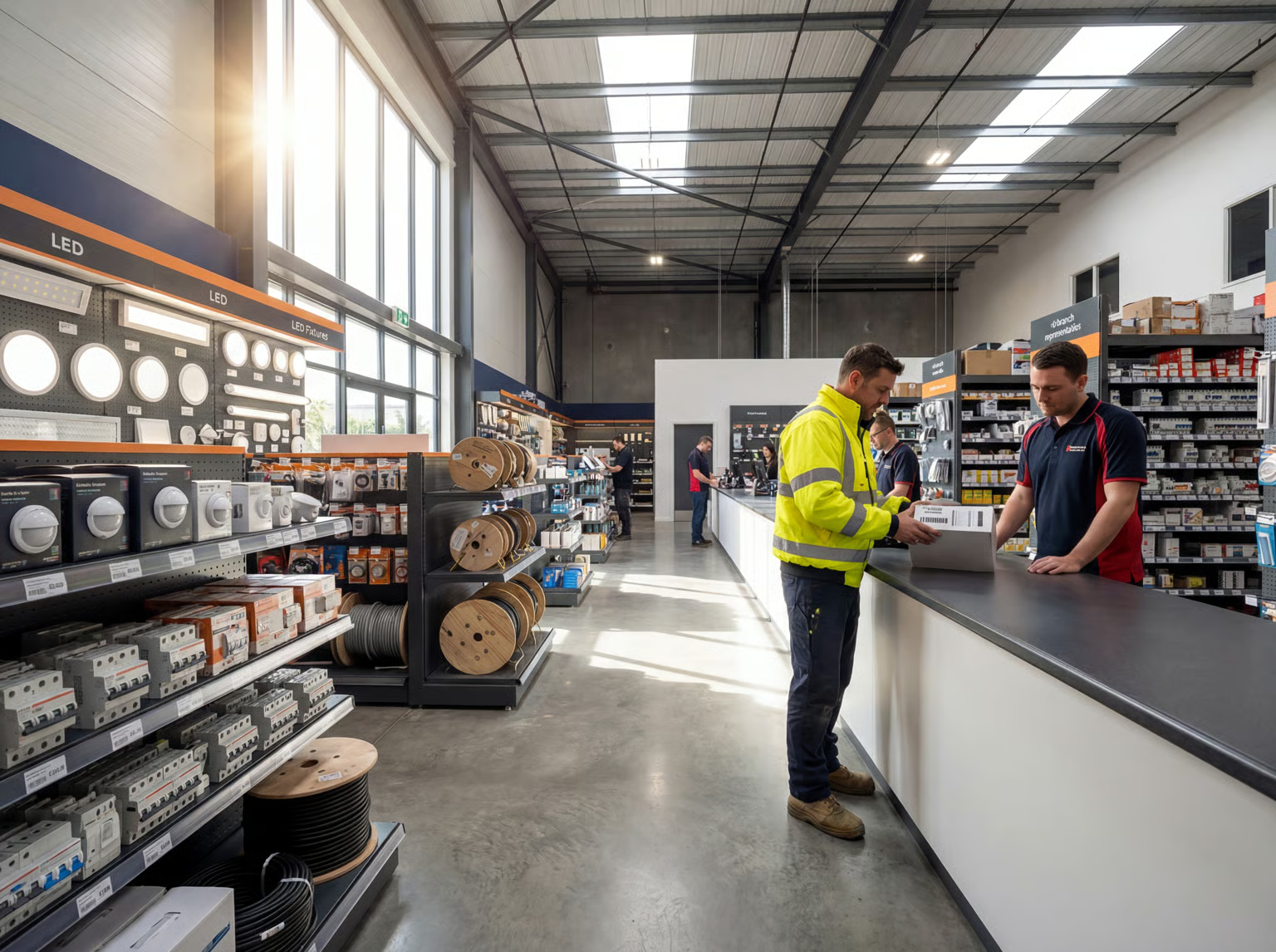
The electrical and lighting supply chain is fast-moving, fragmented, and heavily dependent on immediate product availability. Consignment stock solves the visibility, availability, and capital-loading issues that restrict sales, but only if the process is managed systematically.

Read more

Start Managing Consignment the Modern Way

Streamline transfers, close cycles cleanly, and automate reconciliation. Built for scale, from a single contractor to a national distribution network.